

Research
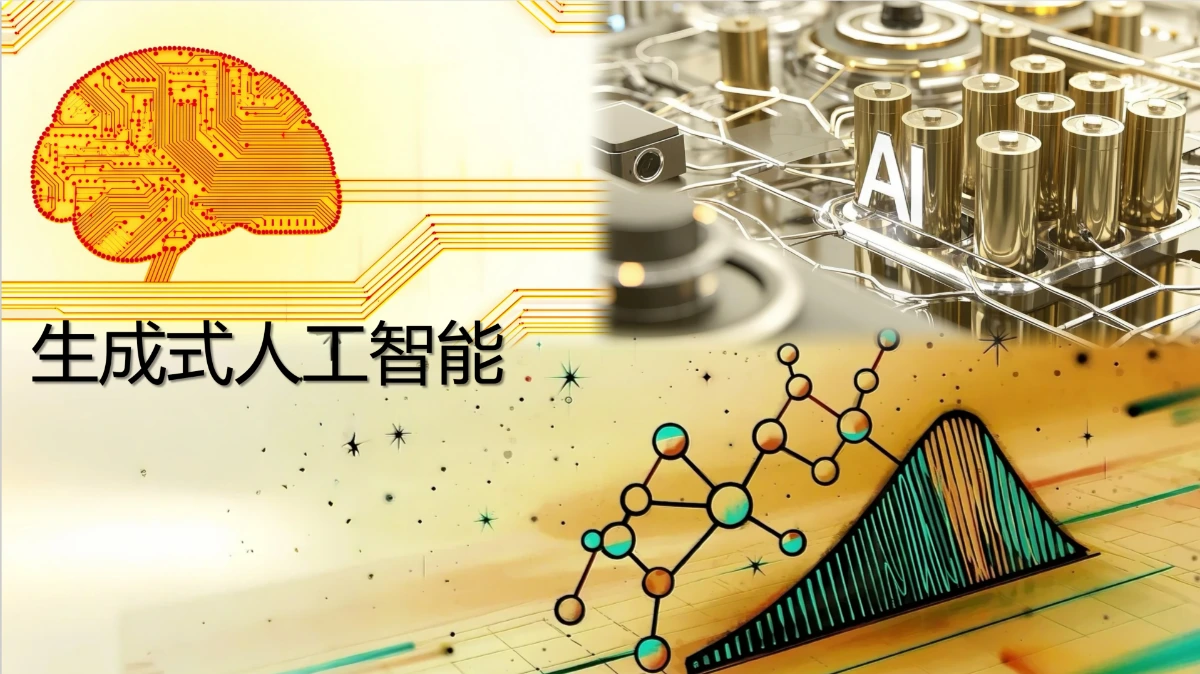
Generative Artificial Intelligence
The Generative AI Research Group focuses on three core research areas: Generative Distribution Modeling, Data-Driven Electroplating, and Reconfigurable Battery Systems. The group is dedicated to advancing the deep application of Generative AI in materials science and chemistry. Group members come from interdisciplinary fields including Computer Science and Chemical Materials, with the goal of enhancing innovation and application capabilities in materials and energy through cutting-edge technologies such as generative models and data-driven methods.
Research Directions
- Generative Distribution Modeling)
We develop algorithm frameworks based on generative models (such as GANs, VAEs, Diffusion models, etc.) to achieve large-scale chemical material structure distribution generation and explore the configuration space of small molecules, cluster molecules, and battery materials. This accelerates the virtual screening of new materials, performance prediction (e.g., free energy), and discovery of rare chemical events in chemical processes. - Data-Driven Electroplating
By combining LLM-based literature extraction, generative models, and molecular representation learning, we focus on microscopic molecular property calculations and predictions, high-throughput screening and prediction of additive molecules, and predicting plating hole-filling effects and CVs. We study the key factors in electroplating processes, optimizing plating technology and additive formulations. This approach skips high time and cost-intensive plating experiments, directly searching for additive molecules suitable for different scenarios in the additive space, thus improving the efficiency of electroplating experiments. - Reconfigurable Battery Systems
Using Graph Neural Networks (GNNs) and battery group vector representations, we simulate the series and parallel topological structures of multiple battery packs. By integrating multi-battery group state prediction models and reinforcement learning, AI is used to generate battery topological schemes that adapt to different scenarios, balancing energy density, cycle life, and safety.
Members:

苏沿溢 
刘畅 
吴倩云 
金昱丞 
刘悦阳 
龚玉雷 
谢锴 
黄思婕