

Battery Materials
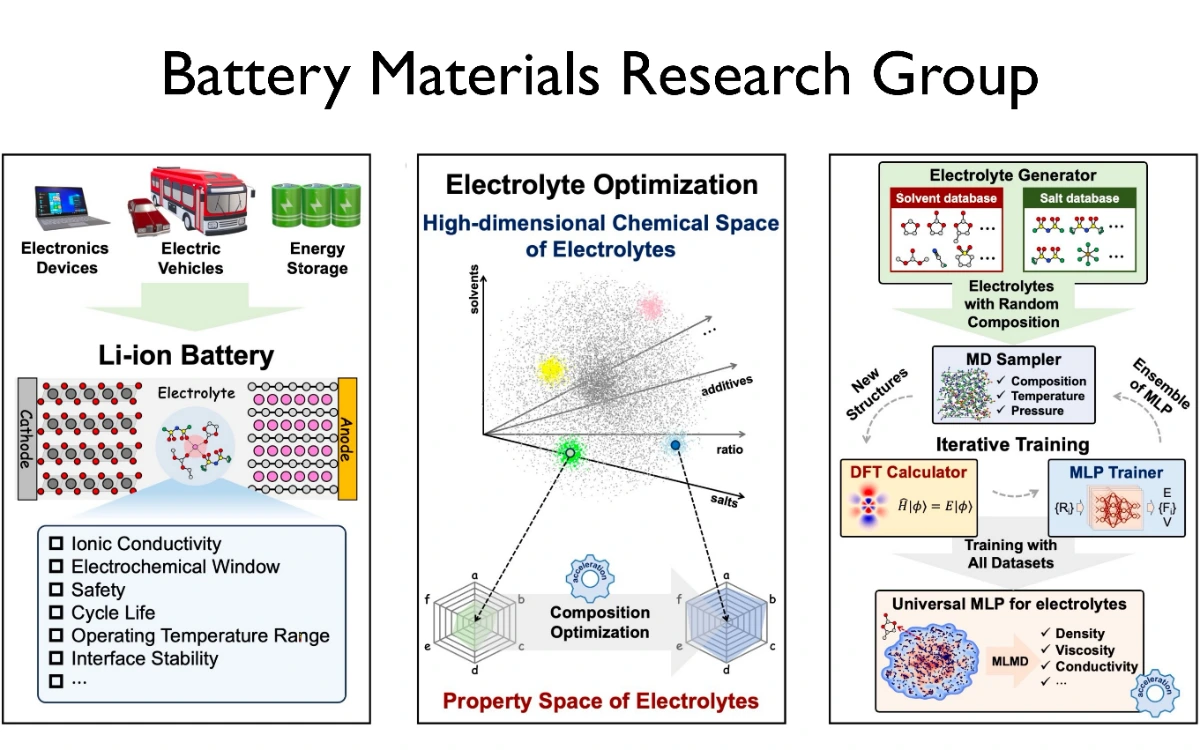
The Battery Materials Research Group focuses on the computation of physicochemical properties of battery systems, the construction of electrolyte knowledge graphs, and intelligent formulation design. Our aim is to develop an end-to-end intelligent research framework that bridges microscopic physicochemical insights with macroscopic performance evaluation through state-of-the-art techniques, including first principles calculations, molecular dynamics simulations, free energy perturbation theory, deep learning neural networks, and large language models. Our team, composed of members from materials science, chemistry, and computer science, is dedicated to establishing a comprehensive and accurate energy storage materials database along with universal potential function models. By integrating experimental data, we drive the intelligent design and optimization of electrolytes and battery materials, thereby advancing the theoretical foundations in materials and energy sciences.
Research Directions
- Computational Assessment of Physicochemical Properties in Complex Electrolyte Systems
Unravel the solvation interaction mechanisms at the microscopic scale by integrating molecular dynamics simulations with free energy perturbation theory. This approach enables the calculation of various physicochemical properties in complex electrolytes, providing essential theoretical support for high-throughput screening. - Machine Learning-Accelerated Automated Property Calculation Workflow
Develop an automated workflow software for electrolyte property calculations that guarantees high-throughput computations with first-principles-level accuracy, ensuring efficient and reliable evaluation. - Universal Electrolyte Models and Large-Scale Database Construction
Employ active learning strategies to construct generalized universal models that encompass solid-state, hybrid, and diverse electrolyte systems. Simultaneously, establish a property calculation database on the scale of tens of millions of data, significantly expanding the material search space for screening purposes. - Electrolyte Knowledge Graph Construction
Leverage large language models to extract and consolidate data from literature, experimental results, and patents. This enables the construction of a multidimensional knowledge graph specific to the electrolyte field, thereby supporting data-driven research initiatives. - Electrolyte Automated Experimental Platform
Integrate large language models to facilitate intelligent recommendations for electrolyte formulations. Develop an automated experimental platform to realize an end-to-end intelligent design solution for electrolytes, streamlining the pathway from concept to practical application.
Future Outlook
We will further integrate high-precision computational simulations, experimental validations, and AI-driven methodologies to continuously optimize the intelligent design workflows for electrolytes and battery materials. The research group looks forward to fostering close collaborations with both national and international academic and industrial partners, jointly driving comprehensive breakthroughs from fundamental theory to practical applications, and establishing a fully integrated, intelligent research paradigm for energy storage materials.

王锋 
唐煜航 
李嘉欣 
徐凡杰 
申英利 
陈奕名 
黄林